
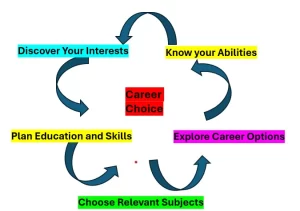
Figure: Overview of the 5-step career decision process.
Introduction:
Young people in many developing countries often lack adequate career guidance. Many students do not know how to choose a career based on informed insight. Schools tend to emphasize white-collar occupations, and some students choose their subjects simply because friends choose them. Others follow in their parents’ footsteps, which is not necessarily bad, but it is not always the right fit for every child.
In many places, secondary school curricula provide limited exposure to career guidance, soft skills, or pathways for self-employment.
The purpose of this article is to help young people better understand their own attributes—natural tendencies, strengths, and interests—so they can make informed, fulfilling career choices. Before going into the steps involved in career decisions, I would like to mention other important perspectives often overlooked in discussions about careers.
Know Yourself.
The subject of vocation or career choice may be looked at from below, from the physical or material angle or from above downwards. In the former we see a human being born to parents. We follow the growth and development of the child, up to when he/she becomes an adolescent and prepares to face life on earth. That is when we often start to think about a suitable career or vocation. However, this is the more limited perspective, because there is more to the child than the physical flesh and blood. I would like to raise the awareness of my readers to the non-physical aspect of man, the looking at man from above downwards. From the spiritual perspective, man is spirit.
This spiritual essence is the real man, the body he wears on earth being just a covering. The essence of man is likened to the “Breath of Life,” that every developing fetus received at a certain stage of development in the womb. It is this spiritual part that makes us human. It is what separates us from other species of matter like stones, plants, and animals.
Without knowing about this essence of the human being, every effort to build a vocation based on the physical aspect of man alone will be half-baked, if not fruitless. A wise saying which has lived in the minds of people of all ages before it became popularized in Greek mythology was “Know Thyself.” In simple terms it means recognizing your essence, your physical mortality, your abilities, and your limits. It is also a call for deep self-reflection and understanding of the nature of your being.
Knowing thyself is to become conscious of the essence of man, to find the answer to the question, what is man? To know where he/she came from, why is it here on earth and where it goes upon leaving the flesh at death. The knowledge of the “what,” “where,” “why” and “where,” will put the understanding of career choices in broader perspectives. Vocations will become more meaningful and a thing of joy to every person and human society.
Put briefly, the essence of man is a spirit spark or spirit particle that came from a part of creation known as the spiritual world. Each of these spirit spark voluntarily embarked on a journey to subsequent (later developed), creation, of which this earth is a tiny component, to gather experiences, call it knowledge, that will enable it to develop its latent qualities and attain self-consciousness or maturity. Only such a mature spirit can use its accumulated experiences to contribute to the further development of the subsequent part of creation. With this goal in view, a vocation or career choice becomes a living, conscious decision-making process. Every earth life will contribute to the continuous development of the maturity of the spirit spark and its subsequent activities to be of service in creation. At the end of this article, I will provide a reference, which will be of help and guidance to anyone who would like to gain more understanding of “Know Thyself,” and the spiritual essence called man.
I would like to discuss the subject of career choice from these five points.
- Know yourself and your Interests
- Know your abilities
- Explore career options
- Choose the right subjects and qualifications
- Gain experience and develop soft skills.
1. Know yourself and your interests
Children often inherit physical traits from their parents, but non-physical traits—such as attitudes, natural inclinations, and soft skills—are shaped by a combination of nature and nurture. Not all children of talented musicians have musical ability, and not all children of teachers become educators. Some may even have the ability but dislike the profession due to subjective experiences or societal perceptions.
Children and youth should be exposed to multiple opportunities so they can naturally identify what aligns with their abilities and interests.
While physical attributes are easy to observe, non-physical traits such as creativity, emotional intelligence, curiosity, and persistence are equally important for career choices. These can be developed or suppressed by the environment, parenting, education quality, and life experiences. A balanced environment can help a child’s latent talents flourish, while an unfavourable one can mask or suppress them.
2. Understanding abilities in childhood
Children begin to display tendencies or behavioural patterns from an early age. Parents who observe closely often notice signs of their children’s natural abilities as early as age three. Some studies show that 35% of parents identified their child’s giftedness between ages three and six.
Regardless of age, parents and schools should expose children and youth to a wide range of environments such as: Manufacturing business, cottage industries, Vocational institutes etc
These experiences stimulate curiosity and expand their horizons. Certain attributes can also signal strengths, and while they should not be taken as fixed labels for a career, they can provide guidance.
Attributes to observe in children includes: Curiosity, Emotional Regulation: Persistence etc.
3. Interest vs. Ability in Career choice
Apart from input from parents and teachers, school career counsellors can support students in making informed choices. Yet young people must also observe themselves.
Should career decisions be based on ability or interest? Both matter—but natural ability is often the stronger guide.
Interest can be influenced by peers or society, while natural inclination usually reflects genuine strengths. For example, Usain Bolt initially wanted to become a footballer. It took the observation and encouragement of a teacher for him to pursue athletics—leading him to become the fastest man in the world.
Students should choose subjects they naturally excel in. Some are inclined towards sciences, others towards arts or humanities, and others towards vocational or technical skills. Identifying this early helps build confidence and avoids unnecessary struggle.
Today, there are thousands of careers, far beyond the traditional options of medicine, engineering, law, teaching, and farming. Students should research widely.
For example, see the Planit Careers List: https://www.planitplus.net/JobProfiles?letter=A
4. Taking the right steps
The Steps involved in making career choices can be divided into
- Interest – List the Careers that interest you, then rank the top three.
- Ability – What are your own abilities? Your abilities can indicate an area where you can excel.
- Choose the right subjects that align with your career interests.
- Take these subjects to career disciplines or professions in which you can qualify.
5. Gain the necessary experience
After qualifications, you need to gain industry experience.
This can be achieved through internships, volunteering or
apprenticeships.
Finally, you need to develop universal soft skills e.g.
communication, problem solving, teamwork, networking, and computer literacy,
especially Artificial Intelligence skills etc.
This short video gives some tips on Soft Skills: https://www.youtube.com/watch?v=4-R1EHKmano
In the broader context of developing oneself as a spirit
spark to full maturity, everyone needs to gain multiple and diverse life
experiences. In addition, one needs to know the fundamental principles of life,
also known as the Laws of Nature (see Reference book below). This knowledge
constitutes an essential part of gaining the skills and experiences to function
well and become useful beings in creation.
Conclusions: Your Career Path Can Change
Choosing a career as a young person is important, but it is not a prison sentence. Many adults change careers once, twice, or even several times during their working lives.
The most important thing is to choose a direction that fits who you are today, while staying open to learning new skills and adjusting as you gain more experience and insight.
As you grow older, your interests and circumstances may change. That is normal. Lifelong learning allows you to adapt to new opportunities.
Appendix1.
Careers Relevant to Developing Countries
While it is good to think globally, it is also wise to understand which careers are in demand in your own country or region. There are so many professions that it will be unfair to attempt to name them for the risk of excluding some.
Many developing countries have growing needs in areas including but not exhaustive to:
Healthcare
- Physician, Surgeon, Nurse, Dentist, Pharmacist, Psychologist, Physical Therapist, Radiologist, Optometrist.
Technology & IT
- Software Developer, Data Analyst/Scientist, Network Administrator, AI Specialist, IT Manager, Web Developer, Systems Analyst
Education & Science
- Teacher, Professor, Librarian, Researcher, Chemist, Biologist, Astronomer, Physicist, Geographer, Sociologist, Anthropologist.
Arts, Media & Entertainment
- Actor, Musician, Writer, Journalist, Photographer, Animator, Curator, Graphic Designer, Newsreader, Flight Attendant.
Trades & Construction
- Electrician, Plumber, Carpenter, Builder, Mechanic, Welder, Construction Worker, Landscaper.
Business & Finance
- Accountant, Financial Analyst, Marketing Manager, Human Resources, Auditor, Salesperson, Business Analyst, Management Consultant, Banker.
Hospitality & Personal Services
- Chef, Bartender, Barista, Hair Stylist, Cosmetologist, Hotel Manager, Fitness Trainer, Childcare Worker, Retail Salesperson, Flight Attendant.
Law & Public Service
- Lawyer, Police Officer, Firefighter, Politician, Social Worker, Judge, Postal Worker, Military Personnel (Soldier, Officer).
Transport & Logistics
- Pilot, Truck Driver, Air Traffic Controller, Logistics Engineer, Railroad Engineer, Captain (naval).
Other Specialized Fields
- Architect, Engineer (various fields), Urban Designer, Agricultural Scientist, Environmental Scientist, Actuary, Economist, Veterinarian, Urban Planner, Mathematician, Statistician, Market Researcher, Event Planner, Real Estate Agent, Archaeologist, Archivist. Small businesses and entrepreneurs: Cottage industries manufacturing, Tailoring, Barbing, Merchandising, Distributorships, Trading.
Young people should look for ways to connect their interests and strengths with sectors. For more details list of professions, please check this web page https://www.planitplus.net/JobProfiles?letter=A
Final Encouragement
Your career is an important part of your life journey, but it is not your entire identity. You are more than your job title. As you choose your path, remember to build good character, strong values, and a willingness to serve others.
Believe in your potential. With the right guidance, effort, and opportunities, you can build a meaningful and satisfying career—no matter where you start from.
Reference book.
When I broached the subject “Know Thyself”, as an endeavour in understanding the spiritual essence of man as a basis for making decisions, including career choices, i promised to refer readers to a source of knowledge in book form that will help and guide anyone who would like to know more about important questions of life and existence. This is not a book on education or career counselling. It is a book that provides a from “Above downwards” perspective about every aspect of life and existence. In publishing this article, I have drawn from my personal understanding and applications of the principles of existence explained in this book and I have no doubt, that anyone who is open-minded and humble will gain tremendously from reading this book.
The understanding and the views reflected in this article are mine, and does not represent what the author of the book has written. These views may therefore not replace your personal responsibility to read and gain the knowledge directly from the source.
I recommend this book to you with all sense of responsibility and duty.
In the Light of Truth: The Grail Message by Abd-ru-shin, published by Alexander Bernhardt Publishing Company, Vomperberg, Austria.
Website: www.alexander-bernhardt.com